

Bulk Infill Grouting (BIG) uses large quantities of low-cost, low-strength cement-based grout to fill subsurface voids — karstic cavities in soluble rock or manmade cavities such as abandoned mine workings — in order to prevent surface subsidence. Depending on the application, the entire cavity can be filled or low-slump grout columns can be built to reinforce a mine roof. BIG can also "pretreat" a rock mass to permit other foundation systems to be built on it. It is not advised in gypsum caves, but can be used in karst topography, chalk deposits, and salt deposits.
The summaries below are organized by source document, matching the nine PDFs on file in this folder — all part of FHWA/SHRP2's "R02: Geotechnical Solutions for Soil Improvement, Rapid Embankment Construction, and Stabilization of Pavement Working Platform" reference series, the same series behind the other technique pages in this library. They're a starting point for understanding the technology and its design logic — not a substitute for a project-specific geotechnical design or a licensed engineer's review.
At a glance
- Best suited to: karst topography, chalk deposits, salt deposits, and abandoned mine voids; not advised in gypsum cave systems
- Design approach: no FHWA design procedure exists — three non-proprietary methods are used depending on application: flush grouting and grout columns (mine subsidence), karstic cavity grouting (sinkholes/karst)
- Watch for: little control over where injected grout travels; difficulty knowing a cavity's exact geometry; unreliable, inconsistent support in common karst conditions
- Quality assurance: coring is often infeasible for low-cement-content grout — pressure-tested test holes and CCTV inspection of the treated area are the typical alternatives
- Complementary technology: Compaction Grouting
- Alternate technologies: piles, drilled shafts, compaction/jet/curtain grouting, deep foundations, excavation and replacement, mine-void implosion via explosives, deep dynamic compaction
Supplementary Graphics
GHRM · Section 17.16.5 · 3 graphics
▼
Supplementary graphics for GHRM Section 17.16.5 (Ground Improvement Technologies). The schematic summarizes how the technique works using the typical values documented on this page; the reference infographics are from the Named Graphics library. Click any graphic to enlarge.
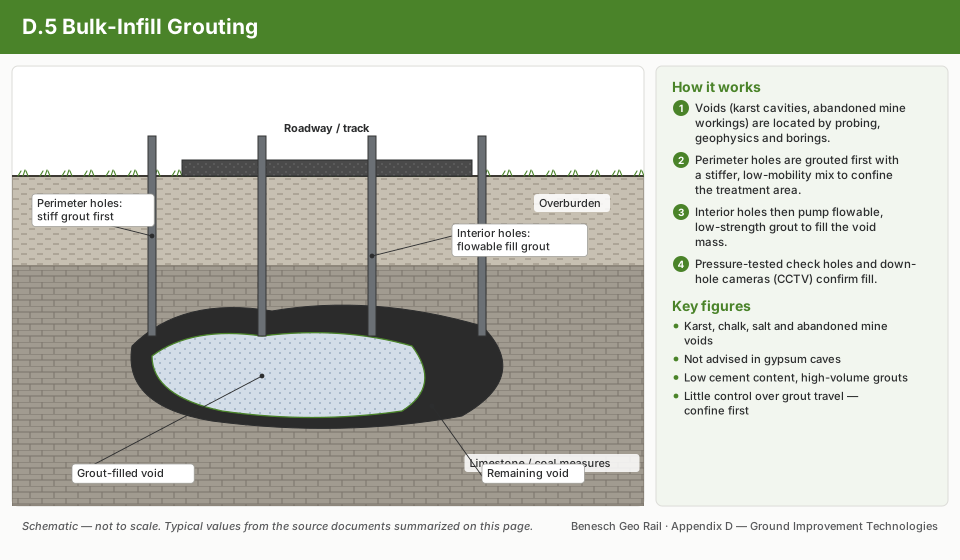
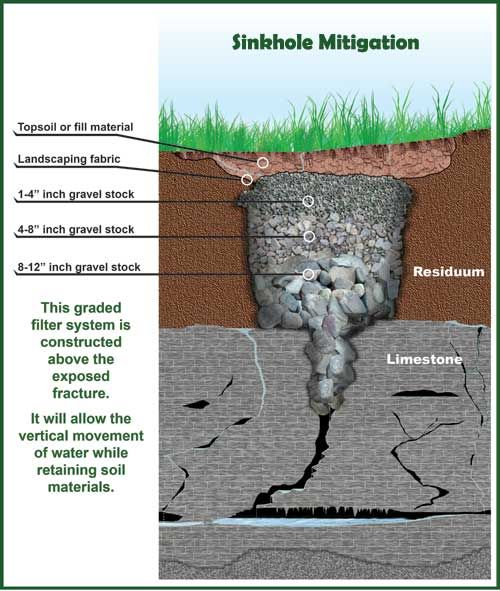
Bulk Infill Grouting — Technology Fact Sheet
GeoTechTools.org · November 2012
▼
BIG fills large subsurface voids — karstic cavities in soluble rock, or manmade cavities such as mines — with large quantities of cement-based grout. The entire cavity can be filled, or low-slump grout columns can be built to reinforce a mine roof. Grout is injected at low pressures or by gravity to the base of the cavity, displacing water and air within it as it fills the cavity or forms a stable support below the roof or between the surrounding ground and a structure. Using BIG on mines involves drilling boreholes into the mine voids to inject grout — either a high-slump grout to fill all voids, or a low-slump grout to construct columns and support the roof. Grout column types include Conventional, Controlled, and Cylindrical Grout Columns. BIG can also "pretreat" rock mass to permit other foundation systems to be built.
| Advantages | Potential disadvantages |
|---|---|
| Low cost per unit volume of materials when using inexpensive fillers | Filling all voids with grout can become cost prohibitive |
| Minimum disturbance | Little control over where the grout goes |
| Strength of grout can be tailored to fit the in-situ condition | Difficulty obtaining sufficient knowledge of a cavity's position, shape, and infilling |
| Essentially yields full roof contact | Cannot provide consistent, reliable support in common karst conditions |
| Grout can penetrate all voids with no fear of it flowing, washing away, or settling | — |
Geologic Applicability
Bulk infill grouting of a gypsum cave system is not advised. It can be used in karst topography, chalk deposits, and salt deposits; all other soil and ground types are not related to bulk infill grouting. Water should be allowed to drain away from the treated area for optimum penetration of the grout.
Additional Information
Grout is typically of low cement content but high volumes of cheaper, readily available materials such as aggregate, flyash, or other industrial waste, and is therefore low strength. Quality assurance includes coring in mitigated areas to confirm the presence of grout, though coring is not feasible for low-cement-content pastes; test holes should instead be drilled and pressure tested with water or grout. Closed-circuit television (CCTV) inspection of the treated area shows good results. Grouting methods will not completely fill all voids. Extensive exploratory and grouting programs are needed in karst terrain to detect all subsurface cavities.
SHRP2 Applications
- Embankment and roadway construction over unstable soils
- Roadway and embankment widening
Example Successful Applications
- Mine Subsidence Control Using Foundation Grouting — PA
- Limestone Cavities Filled at the Southeast Paper Manufacturing — Dublin, GA
- Industrial Plant Site — Lakeland, FL
Complementary and Alternate Technologies
Complementary: Compaction Grouting. Alternate: piles, drilled shafts, compaction grouting, jet grouting, curtain grouting, deep foundations, excavation and replacement, implosion of mine voids through use of explosives, and deep dynamic compaction.
Bulk Infill Grouting — Design Guidance
No FHWA design procedure exists — three non-proprietary methods, used depending on application
▼
No FHWA design procedures currently exist for BIG. Despite the lack of a standard design procedure, various design and construction methods have been developed and implemented on projects across the United States, in both transportation and non-transportation applications: flush grouting, karstic cavity grouting, and grout columns. Which method applies depends on the application — flush grouting and grout columns are used to prevent subsidence from subsurface mine workings, while karstic cavity grouting is used to prevent subsidence from sinkholes and other karst terrain. None of these methods are proprietary.
Flush Grouting▼
Backfills a mine working within the treatment zone using a weak grout. Holes are drilled from the ground surface into the subsurface voids, and grout — typically low-slump yet still fluid — is pumped in, allowing it to fill nearly the entire system of mine voids.
The treatment zone is usually taken as the project area projected downward at a 15° angle of influence outside the structure. Perimeter holes are drilled first, typically on 15- to 25-ft centers, and grouted to contain the grout subsequently pumped into the central area — a thicker grout or crushed stone may be used on the perimeter to help prevent excess grout from flowing out of the treatment zone. Once the perimeter barrier is established, interior holes are drilled, usually on 20- to 25-ft centers, and a weak grout is flushed into the mine until refusal. The grout should be designed to withstand crushing by the weight of overburden.
References: Andromalos and Ryan (1988); Ohio Department of Transportation (1998); Okonkwo et al. (1988); Stump (1988); Woodward (2005).
Karstic Cavity Grouting▼
Injects grout into karstic voids and cavities to mitigate the formation and development of subsidence sinkholes. Grouted voids are typically cavities existing at the soil-rock interface where the overburden is susceptible to piping and, therefore, the development of subsidence sinkholes.
For pretreatment purposes, a grid of injection points is placed over the treatment area, since karstic cavities are unpredictable; subsurface conditions are used to approximate the total amount of grout take needed. If grout injection reaches a certain take, more injection holes may be drilled. For mitigation purposes, grout is injected directly into the throat of the sinkhole. In general, design of a grouting program in karst is heavily reliant on the engineer's professional experience with both karst and grouting.
References: Fischer and Fischer (1997); Madrid et al. (2005); Waltham et al. (2005); Watson et al. (2003); Woodward (2005).
Grout Columns▼
Places low-slump grout columns in mine workings, acting as pillars for the voids resulting from room-and-pillar mining. Holes are drilled to the depth of the voids and used to inject grout, forming typically conical columns. Placement decisions rely heavily on knowledge of the mine void's layout, and the columns must withstand overburden pressures to prevent crushing.
Reference: Stump (1998).
| Category | Typical design inputs / outputs |
|---|---|
| Performance criteria/indicators | Allowable settlements; bearing capacity |
| Subsurface conditions | Stratigraphy; voids (type, size, extent, depth); lithology; groundwater level; permeability; chemistry of rock and groundwater |
| Loading conditions | Layout (angle of draw) |
| Material characteristics | Grout cement-water ratio, mix/additives, permeability, compressive strength; total grout take volume; bleed/stability |
| Construction techniques | Borehole drilling and injection grouting; verification of filling efficiency; grout injection hole spacing |
| Geometry | Width of stabilization work; injection depth |
Bulk Infill Grouting — QC/QA Procedures
No standard FHWA or proprietary method — six methods commonly used
▼
No standard FHWA method for BIG QC/QA exists, nor is one proprietary. Six methods are commonly applied, ranging from simple field tests on the grout mix itself to remote visual inspection of the treated cavity.
Field Quality Control Tests for Grout Mixes▼
Method summary: A set of simple field tests performed on the grout mix as it is batched, verifying consistency with the design mix before and during injection. Common tests include the Marsh Funnel (viscosity/flow time), a penetrometer or shear vane (early-age strength/consistency), the API Filter Press (fluid loss), a graduated cylinder (bleed/settlement of the mix), a Baroid Mud Balance (density), and the Vicat Needle (setting time).
General comments: Fast, low-cost, and performed on-site, making these the primary day-to-day process-control checks for a grouting program.
Borehole Cameras▼
Method summary: Closed-circuit television (CCTV) cameras lowered into boreholes provide direct visual inspection of a treated void or cavity, helping confirm grout coverage and roof contact.
General comments: Useful where coring is impractical (e.g., low-cement-content pastes), since it verifies fill visually rather than by sampling.
Verification Drilling▼
Method summary: Additional boreholes drilled after grouting to confirm that grout has reached and contacted the mine roof or cavity ceiling as intended.
General comments: A direct check on treatment completeness, typically used to supplement the primary grouting hole pattern.
Coring▼
Method summary: Core samples taken from the treated area provide visual documentation of grout placement and, where the mix is strong enough, allow strength testing.
General comments: Not feasible for low-cement-content grout pastes, which are common in bulk infill work; more applicable to stronger, higher-cement mixes.
Grouting Matrix▼
Method summary: A classification chart, developed for karst sites, that combines drilling rate (fast-drilling zones indicate voids) with grout take to categorize subsurface conditions and guide the grouting program.
General comments: Especially useful in karst terrain, where the unpredictable size and location of cavities makes drilling and grout-take data the main source of real-time subsurface information.
Geophysical Testing▼
Method summary: Ground penetrating radar (GPR) and related geophysical methods can help locate voids and assess grout coverage.
General comments: An emerging supplement to drilling-based methods rather than a primary verification tool for BIG.
Bulk Infill Grouting — Specifications
No accepted U.S. transportation specification exists — two guide specifications reviewed
▼
BIG currently lacks an acceptable specification for transportation projects in the United States; specifications for it have rarely been prepared, and those that exist are method specifications rather than performance specifications. Two guide specifications were reviewed: "Bulk Infill Grouting of Old Mines," from Healy and Head (1984), and a "Void Filling Specification," from Elias et al. (2001). Both are method-approach specifications, and both have been included here — but both need to be tailored to project site conditions and adjusted to include the relevant details found in the Design Guidance and QC/QA Procedures above.
| Specification | Type | Applicability |
|---|---|---|
| Bulk Infill Grouting of Old Mines — Healy and Head (1984) | Method approach | Written specifically for abandoned mine workings; the more applicable of the two, but references British standards that must be converted to ASTM/AASHTO equivalents |
| Void Filling Specification — Elias et al. (2001) | Method approach | Originally a rock fissure grouting specification, but stated by its author to apply to any type of subsurface void (karst, mines, etc.); needs modification for a given project |
Preferred Specification
The specification from Healy and Head (1984) is the more applicable of the two, since it is focused specifically on the infilling of mine workings and provides detailed construction procedures for drilling and injecting grout. However, elements of Elias et al. (2001) — which applies more broadly to any type of subsurface void, including karst — should be utilized as well.
Bulk Infill Grouting of Old Mines — Healy and Head 1984 (full outline)▼
A guide specification, from CIRIA Special Publication 32's Appendix B, outlining a contract and specification for consolidating old shallow mine workings. It must be adapted for individual projects, and since it is focused on mine workings, changes are needed before it can be applied to other void-filling applications such as karst terrain.
1. General Contract Provisions: the tender/contract document should include a statement of purpose; instructions for tendering (with confirmation the Contractor has visited the site to assess conditions, particularly surface restrictions); Conditions of Contract; nomination of the Engineer; Form of Tender; Schedule of Rates and Prices and Bill of Provisional Quantities; the Technical Specification; a full factual ground investigation report; and clauses covering special conditions, the Contractor's proposed method of work, evidence of the Contractor's ability to perform the work, site possession/clearance, on-site supervision by an experienced agent (required during drilling, grouting, or testing, and a professional engineer where pressure grouting occurs in a built-up area), normal safety requirements including ground stability and mine gas hazards, measures to prevent pollution from grout effluent/noise/dust, and the location of and responsibility for underground services.
2. Bill of Provisional Quantities, Schedule of Rates and Prices: quantities in ground consolidation work are stated as estimates/provisional, not a guarantee of actual work quantity; rates and prices are inclusive of labor, materials, plant, water/services, transport, overhead, and profit. Quantities and measurements are based on the CESMM or PSA Standard Method of Measurement.
3. Specification — 3.1 Drawings and Geotechnical Information: drawings should indicate provisional primary injection hole locations, plan dimensions of the treatment area at each seam level, seam levels/thicknesses, and known underground services; the Contractor confirms with the Engineer whether supplementary exploratory holes are needed. 3.2 Constituent Materials: water from an approved source; Ordinary Portland Cement (BS 12) or Sulphate Resisting Portland Cement (BS 4027); conditioned or dry-powder PFA from an approved supplier; sand complying with BS 882; bentonite or other approved thixotropic admixture; bulk materials paid by weight, with no payment for excess moisture content over 10% (BS 1881). 3.3 Storage: materials stored to prevent contamination/deterioration; cement kept dry and used in delivery-sequence rotation. 3.4 Grouting Plant: the Contractor submits proposed mixing/batching/pumping methods and pressure/quantity monitoring for approval; materials introduced via approved weight-batching equipment (volume batching may be acceptable given the low strength requirements); the mixer must produce an intimate, homogeneous, non-segregating mix.
3.5 Grout Mixes (proportions by weight, for general guidance): perimeter curtain wall grout for cavities under 500 mm high — Cement:PFA = 1:12, or Cement:PFA:Sand = 1:10:2, with cement content not less than 75 kg/m³ dry (100 kg/m³ waterlogged); for cavities over 500 mm high — Cement:PFA:Sand = 1:6:1 with pea gravel fed simultaneously (weight ratio of grout to pea gravel roughly 1:0.4), cement content not less than 100 kg/m³ dry (125 kg/m³ waterlogged); infill grout — Cement:PFA = 1:12 to 1:20, cement content not less than 50 kg/m³ dry (75 kg/m³ waterlogged). Cube tests are prepared and crushed at 14 and 28 days per BS 1881, with results furnished before grouting where time permits. 3.6 Grout Properties: water/(cement+PFA) ratio of 0.4–0.45, flowability of 300–600 mm (Colcrete-type meter); bleed capacity limited to 5% maximum (measured hourly in a graduated cylinder, over at least 3 h for neat cement grout or 6 h for flyash:cement grout); mixes should crush at not less than 0.7 MN/m² at 28 days. 3.7 Grout Testing: on-site flow meter checks; bleed capacity monitored at 2 h; sets of six test cubes taken from the grouting at surface positions, tested per BS 1881 to confirm 14- and 28-day strength, with mix modifications directed by the Engineer as needed.
3.8 Drilling Procedures: holes drilled by rotary or rotary percussive methods to the pavement of the old workings; minimum diameter 75 mm (perimeter) or 50 mm (infill); cased through superficial deposits (and through rock if directed) and kept open until grouting is complete; perimeter holes spaced at 3-m centers (1.5-m in collapsed ground or where cavities exceed 500 mm), infill holes at 6-m centers unless otherwise specified; obstructed holes are re-drilled at a larger diameter at the Contractor's expense. 3.9 Grouting Procedures: grout tremied to the base of the hole; injection continues until a limiting pressure of 10 kN/m² per m of overburden (200 kN/m² maximum) is reached or grout appears at the injection point. If neither is achieved after 15 tonnes of material, injection is suspended for at least 12 h, then resumed in further 10-tonne then 5-tonne increments with 12-h waits between; if the hole is still accepting grout after 50 tonnes total, the Contractor consults the Engineer on whether to continue or use secondary/test holes. Perimeter curtain-wall grouting begins at the deepest point and progresses to shallower areas, leaving final perimeter holes ungrouted until infill grouting is nearly complete; infill holes are grouted from the deepest point, no less than 6 h after (and at least three rows behind) curtain-wall grouting. Care is taken to avoid uplift under adjacent structures, with precise leveling monitoring where structures might be affected.
3.10 In-Situ Testing: permeability tested via grout-acceptance testing in additional test holes; strength tested via core samples from newly drilled or re-drilled holes, as directed by the Engineer — both paid per the Bill of Quantities. 3.11 Records: the Contractor maintains and daily updates plans/sections showing hole positions, surface levels, and results, plus separate Daily Records for Drilling, Grouting, and Materials/Plant Received, signed and submitted daily for the Engineer's agreement. Daily Drilling Records capture 20 items including job/location, hole reference, date, contractor, plant/crew/hours, drilling method and flushing medium, casing type/diameter/depth, standing time, underground services located, settlement/heave, daily and cumulative drilled length, stratum changes and description, groundwater depth, sample depths, voids/suspended workings, gas/water emissions, and completed hole depth. Daily Grouting Records capture 9 items including job/location, hole reference, date, contractor, plant/crew/hours, injection type and grout-line dimensions, grout mix and volumetric quantity injected, grout pressures with corresponding depths, and details of any abandoned casing.
Rock Fissure & Void Filling Specifications — Elias et al. 2001 (full outline)▼
Two related sections from Elias et al.'s FHWA "Ground Improvement Technical Summaries" cover the general specification of grouting for rock fissures and for void filling; the author notes both can be adapted to bulk infill grouting applications such as karst and mine voids.
Rock Fissure Grouting Specifications — Specification Elements: because more geologic information is typically learned during construction than during design exploration, specifications should retain flexibility to accommodate adjustments — commonly some work is done on a time-and-materials basis, and bidders are ideally given the opportunity to propose alternative approaches, materials, or equipment. Most rock grouting has historically been for dam and tunnel curtain grouting, where agencies have experience and use method specifications; for an unusual project, a performance specification may be preferable. Specifications for rock foundation grouting are often 30+ pages, addressing: Drilling Equipment — rotary or rotary-percussive methods with water flush generally permitted; diamond drilling rarely justified; equipment must allow drilling entirely with water circulation (foam allowed if water alone can't clear cuttings); side-discharge bits disallowed except in fresh, hard rock; drilling below an observed loss of circulation is prohibited unless the MPSP system is used. Grouting Equipment and Procedures — colloidal mixers specified; progressive cavity pumps not an absolute requirement; automatic recording equipment used; the contractor must ensure accurate proportioning, demonstrated via frequent field viscosity/specific-gravity tests.
Construction Control: because the size, continuity, and interconnection of groutable openings remain largely conjectural even after exploratory borings, a carefully monitored and analyzed drilling/grouting program is itself a valuable exploration tool, provided the data is correlated and analyzed. Procedures vary by project, geology, and contractor judgment across drilling, washing, pressure testing, mix selection/adjustment, grouting pressures, hole flushing, additional-hole decisions, surface-leak treatment, and record-keeping. Drilling Operations — a daily drilling record of all pertinent data is kept during operations. Grouting Operations — washing holes immediately before injection removes drill cuttings and fracture-fill material; pressure testing (initiated with a 10-minute steady-pressure water injection, inflow measured each minute, ideally a multipressure test) indicates foundation permeability, locates permeable zones, verifies packer seating, and evaluates washing effectiveness; injection pressures are raised in slow increments toward a refusal criterion, watching for a sudden rate increase with a pressure drop (indicating lifting); a maximum pumping rate of about 0.085 m³/min is typical for foundation grouting; split spacing is the standard sequencing approach, with upstage/downstage/MPSP selection being site-specific; geologic profiles and monitoring data are kept current throughout and folded into the as-built report; evaluation of grouting effectiveness is continuous and collaborative between engineering and construction staff, with prompt reaction to problems. Completion of Grouting — ideally continued to absolute refusal (zero flow at maximum allowable pressure), though the project designer typically sets a practical maximum injection pressure per meter of depth and refusal flow rate based on geology and program objectives instead.
Void Filling Specifications: because it is often difficult to obtain enough exploratory information to accurately define a cavity's extent, the drilling/grouting operation should be treated as a continuation of the subsurface investigation. A method specification, with quantity estimates for bidding and provision for quantity changes, is typical (and can be used for fabric-tube scour repair); for slabjacking, where final slab elevation tolerance is critical, a performance specification is preferred over a method specification when outside variables like traffic can be controlled. Void filling by grouting alone otherwise follows the rock fissure grouting points above.
Bulk Infill Grouting — Cost Information
GeoTechTools.org · November 2012 · cost ranges based on 2005–2010 data
▼
Payment for BIG typically consists of a drilling pay item measured by the lineal foot (LF) and a grouting pay item measured by the cubic yard (CY); layout of the drilling pattern and instrumentation/monitoring/QC are usually incidental to these items, while mobilization is measured and paid separately. Production rates are highly variable, depending primarily on the volume of voids to be filled and, to a lesser degree, on borehole diameter and the grout injection method (gravity or pressure).
| Pay item | Quantity range | Unit | Low unit price | High unit price | Factors that may impact cost |
|---|---|---|---|---|---|
| Mobilization | 1 | Lump sum | $5,000 | $25,000 | Equipment mobilized (drill rigs, compressors, pumps); on-site mixing plants may be needed above 5,000 CY; cost increases beyond 500 miles; phased projects may need multiple mobilizations |
| Drilling | Greater than 500 | LF | $10.00 | $25.00 | Density and hardness of material drilled affects production rate; abrasiveness impacts wear-item costs |
| Grouting | 500 to 25,000 | CY | $75.00 | $250.00 | Sensitive to grout mix proportions, particularly portland cement volume; local availability/freight for fillers (sand, fly ash); pressure grouting costs more than gravity filling |
Historical Cost Information
| Pay item | Quantity | Unit | Low unit price | High unit price | Bid date | Source/Agency |
|---|---|---|---|---|---|---|
| Misc. Drilling Inspection and Grouting Holes | 7,475 | LF | $19.00 | n/a | 12/18/2009 | Missouri DOT |
| Misc. High Slump Grout Material | 7,325 | CY | $55.00 | n/a | 12/18/2009 | Missouri DOT |
| Misc. Low Slump Grout Material | 7,325 | CY | $75.00 | n/a | 12/18/2009 | Missouri DOT |
| Misc. Flowable Fill for Infill | 6,529 | CY | $113.00 | $120.00 | 6/29/2005 | Missouri DOT |
| Pressure Grout | 1,500 | CY | $80.80 | $150.00 | 3/7/2008 | Michigan DOT |
| Drilling Holes for Pressure Grouting | 308 | EA | $306.00 | n/a | 4/30/2008 | Florida DOT |
| Pipe for Grout Installation | 3,080 | LF | $18.05 | n/a | 4/30/2008 | Florida DOT |
| Pressure Grouting — Subsurface, Sand Cement Mix | 161 | CY | $328.00 | n/a | 4/30/2008 | Florida DOT |
Interstate 70 in Guernsey County
Guernsey County, OH · Ohio Department of Transportation · 1995
▼
A 13 ft by 10 ft (4 m by 3 m) deep subsidence suddenly developed in the eastbound lane of I-70 as a result of an underlying mine working, closing the road for more than three months over a 2,000-linear-foot project length while a grouting remediation program was performed.
Subsurface Conditions
Mined-out voids existed at a depth of approximately 66 ft (20 m) below ground surface.
Design & Construction
High-volume grouting using a flyash grout was specified to completely fill all subsurface mine voids. Approximately 1,800 boreholes were drilled down to the mined coal seam using air rotary drilling, which sometimes forced water from water-filled abandoned mines out of nearby holes. Approximately 18,000 CY (13,800 m³) of grout was pumped into the subsurface voids. Two land bridges, 700 ft (213 m) and 110 ft (34 m) long, were constructed over areas where drilling encountered high concentrations of caved and broken material at the mined level. The project ran from March 1995 to July 1995.
Cost Information
The total project cost, including land bridges and pavement replacement, was $3.6 million.
Project technical paper: Ruegsegger, L.R. and Lefchik, T.E. (1999), "Managing Car-Crunching Sinkholes," Public Roads, 63(1).
Pennsylvania Turnpike Service Plaza
Pennsylvania · PennDOT · 1996
▼
Sinkholes developed near three fuel storage tanks at a Pennsylvania Turnpike service plaza. An exploratory/grouting program using a conventional (sand, cement, water, and bentonite) grout mix was used to seal the subsidence sinkholes and improve the underlying foundation.
Subsurface Conditions
Underlying bedrock of limestone, dolomite, quartzite, and quartz schist had been subject to fracturing and increased solutioning in the past, with numerous open channels and soil-filled cavities; a small fault was believed to trend through the storage tank site. Rock depths varied from 35 to 65 ft (10.7 to 19.8 m) below ground level.
Design & Construction
Sheet piles were installed in a 41 ft by 36 ft (12.5 by 11.0 m) rectangular area outside the tank locations; the existing tanks were removed and the area backfilled with 3/8-in (10 mm) stone, which complicated drilling by requiring casing to limit grout flow into the stone. Exterior grout holes were drilled 10 ft (3.0 m) on center, 2 ft (0.6 m) inside the sheet pile perimeter; steel casings and PVC tremie pipes were installed, with the outer steel casing later removed from the initial boreholes. Grouting began three days after drilling, using sand, cement, water, and bentonite (to control shrinkage); calcium chloride (to accelerate set time) was added at exterior probe holes with excessive grout takes, to limit grout movement outside the remediation area. Grout was mixed in a double-tub mixer and delivered with a single-piston pneumatic pump. Thirty-nine boreholes were drilled, and 57 CY (44 m³) of grout was placed.
Alternate Technologies
A reinforced concrete slab, deep foundations, and excavation and fill were considered; bulk infill grouting was selected to fill the subsurface karstic voids at a new location, and the tanks were relocated to the remediated area.
Project technical paper: Fischer, J.A. and Fischer, J.J. (1997), "Investigation and Remediation of Service Plaza Fuel Storage Tanks in Karst," Proceedings of the 48th Annual Highway Geology Symposium, University of Tennessee, Knoxville, pp. 14–23.
Bulk Infill Grouting — Photographs
GeoTechTools.org · November 2012
▼
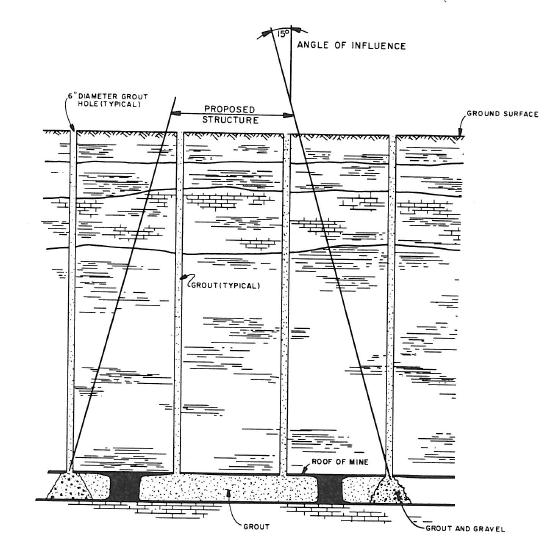
From Ryan (1983), courtesy of GeoCon®.
References
GeoTechTools.org · November 2012
▼
- American Society of Civil Engineers (1983). "Thousands of Tons of Grout Pumped to Stop Mine Subsidence." Civil Engineering, 53(11), 18.
- Andromalos, K.B. and Ryan, C.R. (1988). "Subsidence Control by High Volume Grouting." ASCE Geotechnical Special Publication 19: Mine Induced Subsidence: Effects on Engineered Structures, 53–68.
- Beattie, A., Predika, R. and Beddoes, R. (2006). "Paste Backfill of Shallow Mine Workings for Land Reclamation in Canmore, Alberta." Sixth Biennial Abandoned Underground Mine Workshop, Rochester, New York, June 14–16.
- Bourland, M.L. and Meier, L. (2002). "Lessons Learned from Pressure Grouting an Open Shaft." Fourth Biennial Abandoned Underground Mine Workshop, Davenport, Iowa, May 1–3.
- Branthoover, G.L. and Richards, J.W. (1980). "Mine Subsidence Control Using Foundation Grouting, Southwestern Pennsylvania." Proceedings of the Eighteenth Annual Engineering Geology and Soils Engineering Symposium, Boise, Idaho, 323–337.
- Bruce, D.A. (1992–2007). Various papers on American grouting practice and grouted cut-offs, including "Trends and Developments in American Grouting Practice" (I.C.E. Conference, 1992), "Innovations in American Grouting Practice" (ASCE Metropolitan Section, 1993), "An Overview of Grouting Developments" (Geotechnical News, 1994), "Managing the Design and Construction of Grouted Cut-Offs in Emergency Conditions" (GeoDenver, 2007), and "Pregrouting for Tunnels in Rock: The Case for New Thinking" (GeoDenver, 2007).
- Bruce, D.A. and Dugnani, G. (1994). "Innovations in American Grouting Practice." International Symposium on Anchoring and Grouting Techniques, Guangzhou, China, December 7–10.
- Bruce, D.A., Littlejohn, G.S. and Naudts, A.M. (1997). "Grouting Materials for Ground Treatment: A Practitioner's Guide." ASCE Geotechnical Special Publication No. 66: Grouting: Compaction, Remediation and Testing, 306–334.
- Chuaqui, M. and Bruce, D.A. (2003). "Mix Design and Quality Control Procedures for High Mobility Cement Based Grouts." Grouting and Ground Treatment, ASCE Geotechnical Special Publication No. 120, New Orleans, LA, 1153–1168.
- Committee on Grouting of the Geotechnical Engineering Division (1980). "Preliminary Glossary of Terms Relating to Grouting." Journal of the Geotechnical Engineering Division, 106(GT7), 803–815.
- DePaoli, B., Bosco, B., Granata, R. and Bruce, D.A. (1992). "Fundamental Observations on Cement Based Grouts (1): Traditional Materials." ASCE Conference, "Grouting, Soil Improvement and Geosynthetics," New Orleans, LA, 474–485.
- Destephen, R.A. and Wargo, R.H. (1992). "Foundation Design in Karst Terrain." Bulletin of the Association of Engineering Geologists, 39(2), 165–173.
- Dodd, W.E. (2000). "Fly Ash Use in Pressurized Grout Remote Backfilling of Abandoned Underground Mines in North Dakota." Third Biennial Workshop on Abandoned Underground Mines Workshop, Kansas City, Missouri, April 25–27.
- Elias, V., Welsh, J., Warren, J. and Lukas, R. (2001). "Ground Improvement Technical Summaries." Volume II. Federal Highway Administration Publication No. FHWA-SA-98-086R.
- Fernando, D.A. (1988). "Review of Subsidence and Stabilization Techniques." ASCE Geotechnical Special Publication No. 19: Mine Induced Subsidence, 189–206.
- Fischer, J.A. and Fischer, J.J. (1997a). "Geotechnical Constraints and Remediation in Karst Terrane." Proceedings of the 32nd Symposium on Engineering Geology and Geotechnical Engineering, Boise, Idaho, 279–290.
- Fischer, J.A. and Fischer, J.J. (1997b). "Investigation and Remediation of Service Plaza Fuel Storage Tanks in Karst." Proceedings of the 48th Annual Highway Geology Symposium, Knoxville, Tennessee, 14–23.
- Fischer, J.A., Fischer, J.J. and Ottoson, R.S. (2001). "Remediation in karst — art, science, witchcraft, and economics." Proceedings of the Eighth Multidisciplinary Conference on Sinkholes and the Engineering Impacts of Karsts, Louisville, Kentucky, April 1–4.
- Fischer, J.A., Fischer, J.J. and Ottoson, R.S. (2003). "Grouting in Karst Terrane — Concepts and Case Histories." ASCE Geotechnical Special Publication No. 120: Grouting and Ground Treatment, 953–966.
- Fischer, J.A., Greene, R.W., Fischer, J.J. and Gregory, F.W. (1992). "Exploration/Grouting in Cambro-Ordovician Karst." ASCE Geotechnical Special Publication No. 30: Grouting, Soil Improvement and Geosynthetics, 350–359.
- Fuller, A., Westland, J. and Blakita, P.M. (2007). "Grouting Beneath a Main Output Transformer at the Pickering Nuclear Generating Station." GeoDenver, February 18–21, Denver, CO.
- Gallagher, P.E. (2000). "Mine Subsidence Stabilization in Steeply Dipping Seams in the Canadian Rockies: A Project Overview." Third Biennial Workshop on Abandoned Underground Mines Workshop, Kansas City, Missouri, April 25–27.
- Garlanger, J.E. (1984). "Remedial measures associated with sinkhole-related foundation distress." Proceedings of the First Multidisciplinary Conference on Sinkholes, Orlando, Florida, 335–341.
- Gause, C.C. and Bruce, D.A. (1997a–c). "Great Grouts" and "Control of Fluid Properties of Particulate Grouts" (Parts 1–2). Civil Engineering and ASCE Geotechnical Special Publication No. 66.
- Gularte, F.B., Taylor, G.E. and Shao, L.S. (2007). "Observational Monitoring Methods for Improved Grouting and Soil Improvement." GeoDenver, February 18–21, Denver, CO.
- Healy, P.R. and Head, J.M. (1984). "Construction over abandoned mine workings." CIRIA Special Publication 32, CIRIA, London.
- Holmquist, D.V., Thomas, D.B. and Simon, K. (2003). "Subsidence Mitigation Using Void Fill Grouting." ASCE Geotechnical Special Publication No. 120: Grouting and Ground Treatment, 1103–1114.
- Houlsby, A.C. (1990). Construction and Design of Cement Grouting: A Guide to Grouting in Rock Foundations. New York: John Wiley and Sons.
- Karfakis, M., Barnard, S. and Murphy, J. (1988). "Subsidence Abatement Projects in Wyoming — An Overview." ASCE Geotechnical Special Publication 19: Mine Induced Subsidence, 33–52.
- Madrid, L.D., Stach, R., Murphy, B.K. and Chinault, M.W. (2005). "Estimating Grout Quantities for Residential Repairs in Central Florida Karst." ASCE Geotechnical Special Publication No. 144: Sinkholes and the Engineering and Environmental Impacts of Karst, 243–249.
- Marino, G.G. and Abdel-Maksoud, M.G. (2006). "Protection Measures against Mine Subsidence Taken at a Building Site." Journal of Materials in Civil Engineering, 18(2), 152–160.
- Marks, B.D. (1997). "Stabilization of Karst Features on Major Engineering Projects." Proceedings of the 48th Highway Geology Symposium, Knoxville, Tennessee, 37–48.
- Millet, R.A. and Engelhardt, R.L. (1982). "Matrix Evaluation of Structural Grouting of Rock." Proceedings of the Conference on Grouting in Geotechnical Engineering, New Orleans, Louisiana, 753–768.
- Mitchell, J.M. and Jardine, F.M. (2002). A Guide to Ground Treatment. London: CIRIA.
- Moore, H.L. (2006). "A Proactive Approach to Planning and Designing Highways in East Tennessee Karst." Environmental & Engineering Geoscience, 12(2), 147–160.
- Müller, R. and Bruce, D.A. (2000). "Equipment for Cement Grouting: An Overview." ASCE Geotechnical Special Publication No. 104: Advances in Grouting and Ground Modification, 155–172.
- Ohio Department of Transportation (1998). "Manual for Abandoned Underground Mine Inventory and Risk Assessment." May 15.
- Okonkwo, I.O., Judd, W.R. and Altschaeffl, A.G. (1988). "A Review of Some Aspects of Grouting for Mine Subsidence Control." ASCE Geotechnical Special Publication 19: Mine Induced Subsidence, 127–146.
- Peng, S.S. (1978). Coal Mine Ground Control. New York: John Wiley & Sons.
- Peterson, W.K., Meyers, J.R. and Mackey, R.R. (2003). "Sinkhole Remediation Measures for a Highway in King of Prussia, Pennsylvania." ASCE Geotechnical Special Publication No. 122: Sinkholes and the Engineering and Environmental Impacts of Karst, 569–579.
- Predika, R. (2006). "Large Scale Backfilling of Shallow High-Extraction Room and Pillar Coal Mines for Residential Development." Sixth Biennial Abandoned Underground Mine Workshop, Rochester, New York, June 14–16.
- Ruegsegger, L.R., Beach, K.D. and Rahmlow, F. (2002). "Interstate 77 Abandoned Underground Mine Remediation Project." Proceedings of the 53rd Annual Highway Geology Symposium, San Luis Obispo, California, 273–283.
- Ruegsegger, L.R. and Lefchik, T.E. (1997). "Abandoned Underground Mine Inventory and Risk Assessment." Proceedings of the 48th Highway Geology Symposium, Knoxville, Tennessee, 75–84.
- Ruegsegger, L.R. and Lefchik, T.E. (1999). "Managing Car-Crunching Sinkholes." Public Roads, 63(1).
- Ryan, C.R. (1979). "Grouting to Correct Coal Mine Pollution and Subsidence Problems." Geotechnical Exhibition and Technical Conference, Chicago, IL, March 28.
- Ryan, C.R. (1983). "Use of Flyash to Solve Coal Mine Subsidence and Fire Problems." Lehigh Valley Section ASCE, Disposal of Solid and Liquid Wastes, Lehigh University, April 28.
- Ryan, C.R. (1984). "High-volume grouting to control sinkhole subsidence." Proceedings of the First Multidisciplinary Conference on Sinkholes, Orlando, Florida, 413–417.
- Sowers, G.F. (1984). "Correction and protection in limestone terrane." Proceedings of the First Multidisciplinary Conference on Sinkholes, Orlando, Florida, 373–378.
- Stump, D.E. (1998). "Grouting to Control Coal Mine Subsidence." ASCE Geotechnical Special Publication No. 80: Grouts and Grouting: A Potpourri of Projects, 128–138.
- USACE (1984). "Engineering and Design: Grouting Technology." EM 1110-2-3506, U.S. Army Corps of Engineers, Washington, D.C.
- Waltham, T., Bell, F. and Culshaw, M. (2005). Sinkholes and Subsidence: Karst and Cavernous Rocks in Engineering and Construction. Chichester, UK: Praxis Publishing Ltd.
- Warner, J. (2004). Practical Handbook of Grouting: Soil, Rock, and Structures. Hoboken, New Jersey: John Wiley and Sons.
- Warner, J. (2007). "Proper Grout Rheology Assures Quality Work." GeoDenver, February 18–21, Denver, CO.
- Watson, B.H., Devilbiss, T., Fischer, J.A. and Fischer, J.J. (2003). "Grouting Roadway Sinkholes." ASCE Geotechnical Special Publication No. 122: Sinkholes and the Engineering and Environmental Impacts of Karst, 580–590.
- Weber, W.M. and Popper, G.H. (1997). "Mine Subsidence Remediation Using Multiple Grouting Techniques." ASCE Geotechnical Special Publication No. 66: Grouting: Compaction, Remediation and Testing, 118–132.
- Woodward, J. (2005). An Introduction to Geotechnical Processes. Glasgow, Scotland: Bell & Bain Ltd.